New report: Sustainability requirements in public procurement risk losing their impact
Uncertainty over what constitutes an equivalent label in public procurement risks weakening sustainability requirements and distorting competition. This is the finding of a new legal report from the ModUpp 2030 labelling network. The message to contracting authorities is clear: Require labels, but make sure that equivalence is properly assessed so that procurement requirements are not watered down.
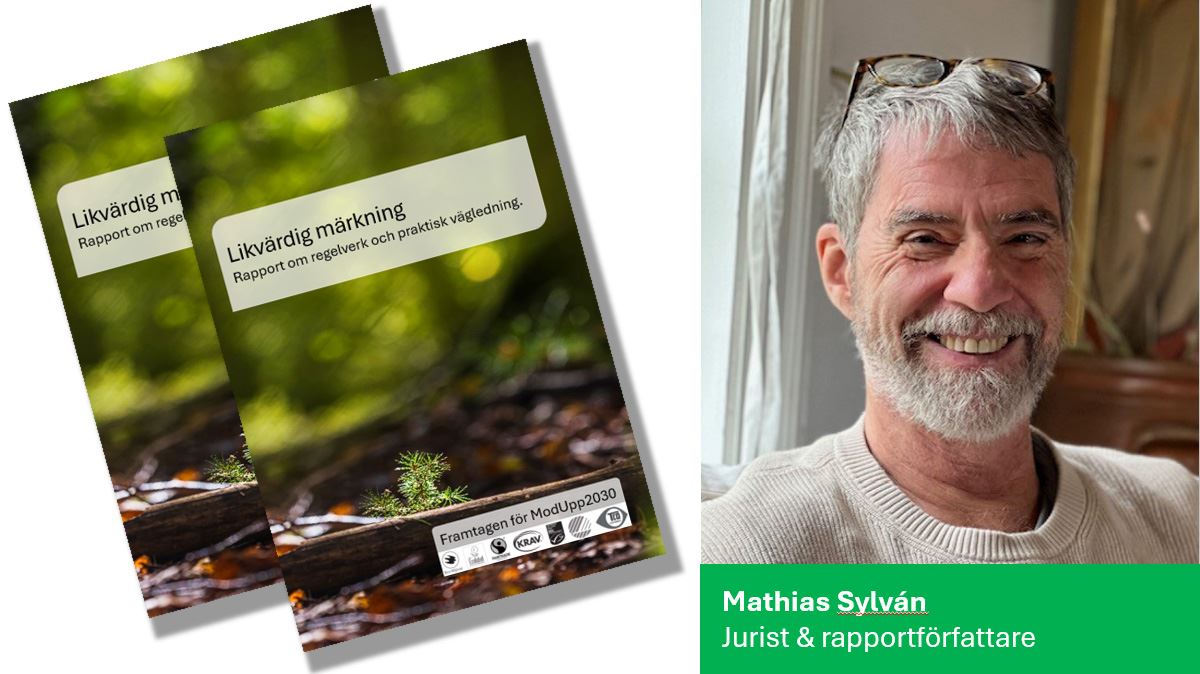
The report, “Equivalent Labels – Report on regulatory framework and
practical guidance”, analyses the rules on equivalent labelling under the Swedish Public Procurement Act (LOU) and shows that overly formulaic assessments can result in labels with less stringent or less comprehensive requirements being accepted instead of the label specified. This risks weakening the role of procurement in promoting environmental and social sustainability, while also putting suppliers that have invested in more stringent labels at a disadvantage.
– It is entirely sufficient for a contracting authority to require a product or service to carry a specific label. The contracting authority does not need to specify the individual requirements included in the label. However, this does not mean that the assessment of equivalence can be superficial; it must meet a certain standard of thoroughness, says Mathias Sylvan, lawyer and author of the report.
The report concludes that contracting authorities do not need to make requirements for labels more complicated than necessary. However, they do need to be clear about which label is required and ensure that any assessment of equivalence is sufficiently thorough to establish equivalence in terms of both the level and scope of the requirements. For the public sector, this is crucial if labels are to serve as an effective tool for driving the sustainability transition.
– For public procurers, sustainability labels are a cost-effective and quality-assured way of achieving sustainability targets. If labels with a lower level of ambition are accepted as equivalent, procurement requirements are undermined, while suppliers have less incentive to develop more sustainable products and services, says Sofie E Munteanu, Head of Sustainable Consumption and Bra Miljöval at the Swedish Society for Nature Conservation.
The aim of the 2014 EU Directive on public procurement was to make it easier for contracting authorities to require sustainability labels directly. Public procurement in Sweden amounts to SEK 1,000 billion annually and has significant potential to deliver both environmental benefits and time savings.
– Through this report, we want to provide support and concrete examples of how equivalent labels can be handled, helping contracting authorities make their day-to-day work more efficient. We also hope that the report will help move public procurement policy higher up the agenda ahead of this autumn's election, says Lena Mårdh, Project Manager for Procurement & Purchasing at Ecolabelling Sweden, which is responsible for the Nordic Swan Ecolabel and the EU Ecolabel in Sweden.
Recommendations for public procurers:
- Clearly specify which label is required.
- Ensure that any assessments of equivalence are neither superficial nor cursory.
- Do not accept labels covering raw materials as equivalent to labels covering the entire final product.
- Consider making the labelling requirement a contract condition to give suppliers more time to obtain the label (or another equivalent label).
- Where appropriate, you may highlight particularly important requirements included in the label.
About the report
Equivalent labelling was produced for the ModUpp 2030 labelling network and analyses how the rules on equivalent labelling in public procurement should be interpreted to ensure that the legislation has its intended effect.
ModUpp 2030 is a labelling network comprising the labels and certifications Bra Miljöval, the Nordic Swan Ecolabel, KRAV, the EU Ecolabel, Fairtrade, MSC and TCO Certified.